
HEK293 Cell Transfection
HEK293 cells are among the most transfectable mammalian cell lines in existence because they take up DNA so readily. HEK293/293T cells are used less often as the manufacturing cell line for final drug products (CHO dominates there) but are absolutely central to research and development in several next-gen biopharmaceutical therapeutic modalities and disease areas. HEK293 and HEK293T cells have high success rates in the production of viral vectors (AAV, adenovirus, lentivirus, and retrovirus) for cell and gene therapy including CAR-T and NK cell therapies, mRNA and LNP based therapeutics for cell and gene therapy applications as well, vaccine development, and now RNAi based therapeutics.
Our team at EZ Biosystems has developed several transfection reagent formulations that are ideal for delivering large plasmid DNA, sgRNA, siRNA, and other nucleic acids molecules into HEK293/293T cells:
Important Note: If you are transfecting into Human Epidermal Keratinocyte cells instead of Human Embryonic Kidney cells, explore our dedicated product line for Human Epidermal Keratinocyte cell transfection: Human Epidermal Keratinocyte (HEK, NHEK) Avalanche® Transfection Reagent.
Our other proprietary transfection formulations work well for HEK cell transfection including other cell lines: Avalanche®-Omni Transfection Reagent, Avalanche®-Everyday Transfection Reagent, and Avalanche®-CRISPR Transfection Reagent (especially if you’re transfecting CRISPR payloads into HEK cells).
The Challenges of HEK293 Transfection
Despite being one of the most transfectable mammalian cell lines in existence today, the challenges of transfecting HEK293 cells does not come from poor uptake, but from specific biological and practical quirks.
Morphology & Adhesion:
HEK293 cells are notoriously poorly adherent as they detach easily during media changes, washing steps, and even pipetting. HEK cells often grow in loosely attached clumps as well which reduces transfection uniformity.
Overgrowth Sensitivity:
HEK cells grow extremely fast which makes timing in transfection protocols important. Hitting the wrong confluency (typically want 60–80%) dramatically drops efficiency. Over-confluent cells transfect poorly and die after lipid transfection.
Cytotoxicity Sensitivity:
Lipid-based reagents, including Avalanche®, can be quite toxic to HEK293 cells at doses needed for hard-to-deliver cargo such as siRNA, sgRNA RNPs. Making sure you are using the current amount of transfection reagents is critical. Our transfection protocols for each of our products includes specific dosage volumes to minimize cytotoxicity errors.
siRNA and sgRNA Specific Issues:
The knockdown efficiency with siRNA can be inconsistent due to high endogenous nuclease activity and rapid cell division diluting effects as previously mentioned. sgRNA delivery is slightly less efficient than plasmid DNA delivery. Our proprietary formulation has increased the transfection efficiency of siRNA, sgRNA, and large plasmid DNA molecules compared to alternative brands.
Comparison with Other Common Cell Lines
| Feature: | HEK293/293T: | CHO: | Sf9: |
|---|---|---|---|
| Transfectability | Very easy | Medium | Medium |
| Adhesion stability | Poor | Good | Suspension/poor |
| Lipid transfection | Excellent | Moderate | Moderate |
| siRNA efficiency | Good but variable | Good | Poor (different RNAi) |
| Viral production | Excellent | Limited | Baculovirus-optimized |
| Serum-free adaptation | Moderate | Excellent | Excellent |
| Genome stability | Poor | Moderate | Moderate |
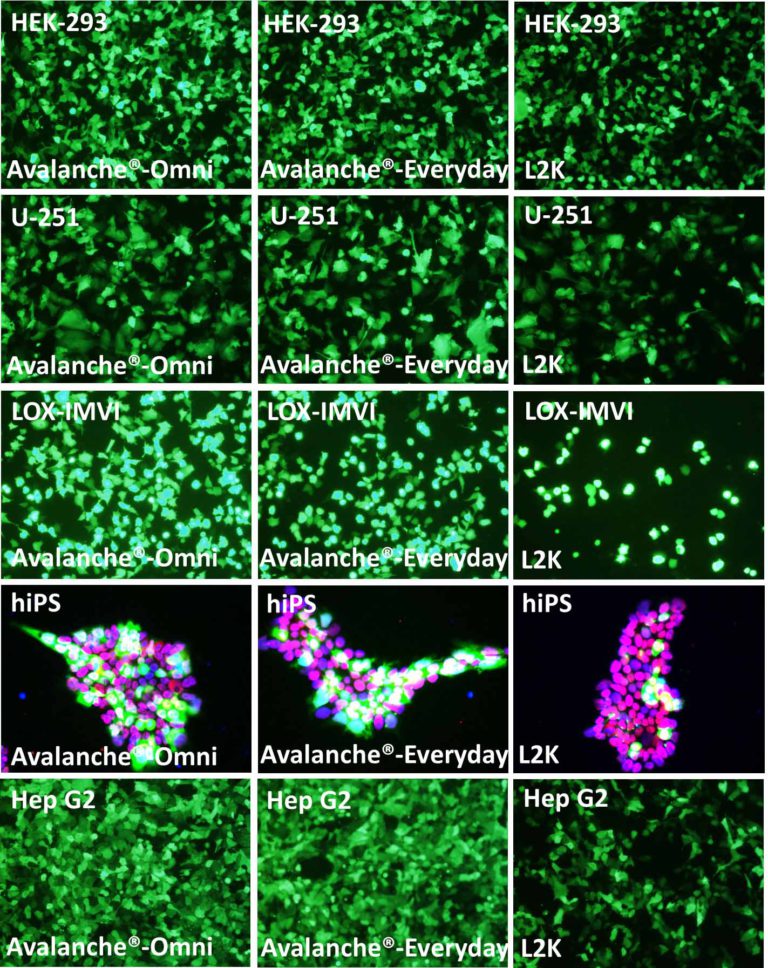
The performance of Avalanche®-Everyday Transfection Reagent is very close to that of Avalanche®-Omni Transfection Reagent. Cell line tested here are: HEK-293, U251, LOX-IMVI, hiPS, and Hep G2.
The cells were transfected with enhanced green fluorescent protein (eGFP) expressing vector by using Avalanche®-Omni, Avalanche®-Everyday, and L2K. Regarding to hiPS cells, after transfection, hiPS cells were fixed with PFA, and stained with OCT-4 antibody (red) and DAPI (Blue). The pictures, which were the overlay of eGFP (green), Oct-4 (red), and DAPI (blue), showed that while all of the hiPS kept their pluripotency after transfection, Avalanche®-Omni and Avalanche®-Everyday showed great eGFP expression.
Avalanche®-Everyday and Avalanche®-Omni are able to achieved more than 90% knockdown of endogenous gene expression in a variety of cell lines and primary cells.
HEK293 vs. HEK293T Key Differences
For transient overexpression and viral vector production, 293T is almost always preferred. For stable integration work, 293 or derivatives may be chosen to avoid SV40-related replication artifacts. Derivatives including HEK293E, HEK293F/FreeStyle, HEK293H, HEK293S, HEK293S GnTI⁻ or 293/KDR have high transfection efficiency with Avalanche transfection reagents. Not sure which transfection reagent to use on your specific derivative cell line? Contact our team.
| Feature: | HEK293: | HEK293T: |
|---|---|---|
| SV40 Large T antigen | No | Yes, stably integrated |
| Episomal Replication | No | Yes, plasmids with SV40 ori replicate to very high copy number |
| Transient transfection yield | High | Much higher for SV40-ori plasmids |
| Lentiviral/Retroviral Production | Industry Standard | Industry Standard but more common because of high titers |
| Protein Expression Level | High | Higher (due to amplified plasmid copy number) |
| Growth Rate | Fast | Slightly faster |
| Neomycin Rsistance | No | Yes |
Learn More About Avalanche® Transfection Reagents for HEK293 Cell Transfection
Our proprietary formulation of lipids and polymers ensures the highest possible transfection efficiencies and viabilities for HEK293/293T cells. No other transfection reagents can match the efficiency, convenience, and gentleness of Avalanche:
If you and your team have technical questions about our transfection reagents, need advice on optimizing your workflow, or have a question about our transfection protocols (all available on each product page), contact our team anytime.
Interested in a sample of our proprietary transfection reagent? Request a sample!