
CRISPR Transfection
CRISPR transfection is the process of delivering CRISPR gene-editing components such as plasmid DNA, mRNA, guide RNA, or Cas9 protein into host cells so the CRISPR-Cas9 system can modify a specific DNA sequence. There are many reasons why CRISPR transfection can be challenging for researchers in biotechnology and biopharmaceuticals. Our team at EZ Biosystems has created the Avalanche®-CRISPR Transfection Reagent to overcome some of these challenges and increase delivery of plasmid DNA, mRNA, gRNA, Cas9 and other nucleic acids.
The Challenges of CRISPR Plasmid Transfection
Although CRISPR plasmid constructs are in fact large, plasmid size is not the only reason why transfection can be challenging. The vectors encoding components necessary for CRISPR-Cas9 genome engineering are always large (9–19 kb), resulting in low transfection efficiency and cell viability, which often requires subsequent selection or downstream purification. But what are the other challenges researchers must consider?
Large Plasmid Size:
Typical CRISPR plasmids contain Cas9 (~4.2 kb), promoter + polyA, sgRNA cassette, and selection marker / reporter, these plasmids may be up to 9-15 kb, and in knock-in HDR plasmids may be >15 kb.
Nuclear Localization Requirements:
Plasmid DNA must enter the host cell, escape the endosome, enter the nucleus, and be expressed while other nucleic acids like mRNA, siRNA, or RNP does not need to enter the nucleus.
Cell Stress from Double Stranded Breaks:
As the Cas9 protein breaks the DNA double strand to edit the sequence, this may trigger p53 responses, apoptosis, and cell cycle arrest. This will lower the health of the average cell and lower overall transfection efficiency.
CRISPR Transfection is not Limited to Plasmid DNA
CRISPR transfection is not limited to plasmid DNA. CRISPR-Cas9 can be delivered in multiple cargo types including DNA (plasmid), mRNA, and ribonucleoprotein (RNP). The duration of expression is largely affected by the speed of biological processes, and depending on the aims of the experiment, certain formats may be preferred. Here is a chart showing the advantages and disadvantages of each format:
| Format: | Common/Uncommon: | Notes: |
|---|---|---|
| Plasmid DNA | Very common | Easiest to produce, hardest to deliver |
| Cas9 mRNA | Common | Faster expression, less toxicity |
| sgRNA only | Used with Cas9 protein | For RNP |
| siRNA | Not CRISPR, but often co-transfected | |
| RNP (Cas9 protein + sgRNA) | Very common | High efficiency |
| HDR donor DNA | Common for knock-in | Large payload |
- RNA systems require nanovectors capable of simultaneously transporting and protecting the relatively unstable Cas9 mRNA and sgRNA, and enabling controlled cytoplasmic release.
- RNP delivery can skip Cas9 protein expression entirely for direct genome editing with notably lower off-target risks, but efficient delivery of RNP remains a serious challenge due to its large molecular size, instability, and low efficiency of endosomal escape.
- siRNA can be delivered alongside CRISPR components (for example, to knock down specific genes transiently or to suppress immune responses during editing), but it is not a core component of the CRISPR editing machinery itself.
Important Transgene Factors for Successful CRISPR Transfection
Similar to the above reasons why CRISPR transfection can be challenging, there are several factors that affect transfection efficiency. These factors should not only be considered before transfection, but are important for improving transfection efficiency and can often be optimized individually.
Plasmid Size/Length:
The SpCas9 expression cassette (>4 kb) combined with the sgRNA cassette, reporter genes, and HDR template generates a large plasmid that is difficult to encapsulate — effective compression of CRISPR/Cas9 plasmids is key to improving transfection. Molecular cloning techniques may shorten plasmid DNA size.
Promoter:
Promoter selection affects how strongly Cas9 is expressed, and the nuclear localization sequence is essential for nuclear entry in non-dividing cells. Strong promoters include CMV, EF1α, and CAG, while weaker promoters include PGK, short EF1α, and SV40.
Repair Strategy:
Researchers need to know whether they’re relying on NHEJ (for knockouts) or HDR (for precise knock-ins), as HDR requires a donor template and the editing efficiency in primary/stem cells can be substantially lower.
Cas9 Variant:
The size of the commonly used Cas9 from Streptococcus pyogenes (SpCas9) limits its utility for certain applications, particularly those using AAV delivery. Cas9 from Staphylococcus aureus (SaCas9) can edit with similar efficiency while being more than 1 kb shorter. Here is a breakdown of common Cas9 variants.
| Cas: | Size: | Notes: |
|---|---|---|
| SpCas9 | Large | Most common |
| SaCas9 | Smaller | Easier delivery |
| Cas12a | Medium | Different PAM |
| Base editor | Very large | Hard to transfect |
Cell Types and Cell Lines That Have Excellent CRISPR Transfection Efficiency
Many genomics and cell/gene therapy researchers are familiar with the excellent transfection efficiency rates of K562, HeLa, and HEK293/HEK293T cell lines because of their fast-dividing nature, tolerance for external DNA, and high endocytosis. Difficult cells, while not impossible, may have lower transfection efficiency because of their non-dividing nature, low uptake, lower tolerance to toxicity, and DNA sensing which may require electroporation, viral delivery (transduction), or further specific transfection reagents. These cells may include primary T cells, iPSC, stem cells, suspension cells, A549, NIH3T3, and Jurkat cell lines.
If you have a question which transfection reagent might work best with your specific cells, contact our team for a recommendation.
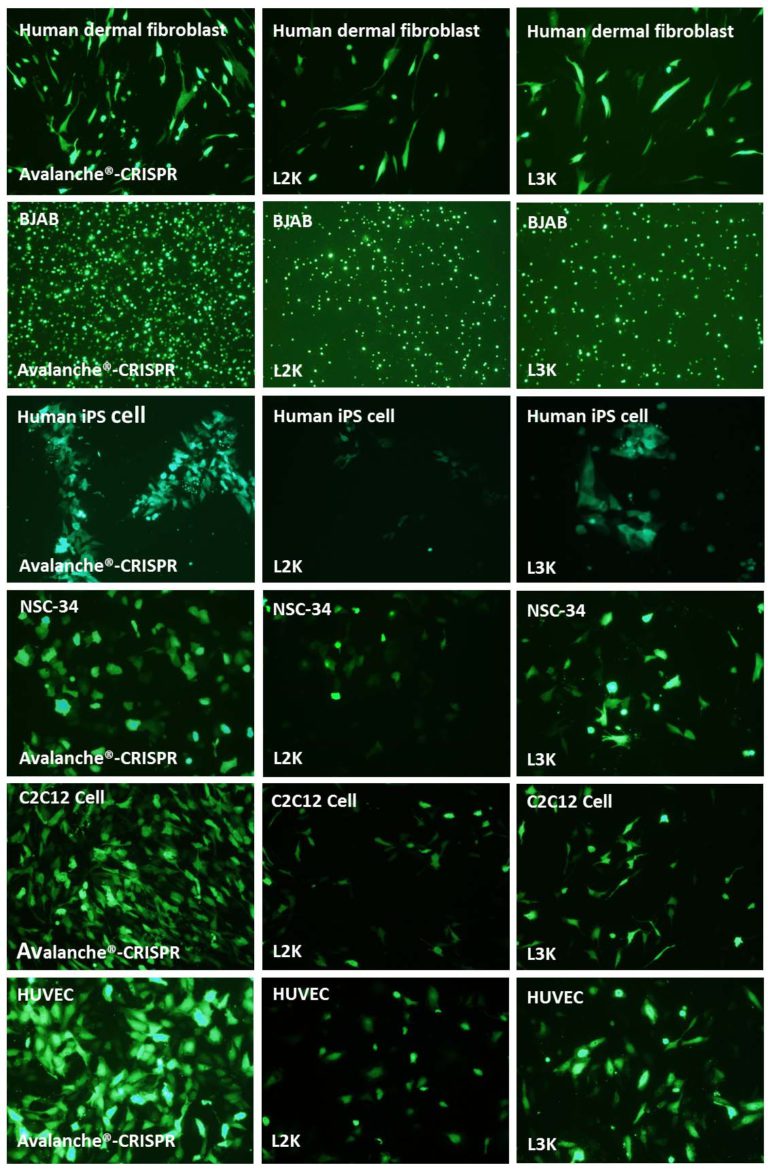
While creating our Avalanche®-CRISPR Transfection Reagents, our team tested their efficiency
on multiple cell lines including human dermal fibroblast, BJAB (human Burkitt lymphoma cell), Human iPS cell, NSC-34 (Mouse Motor Neuron Hybrid Cell), C2C12 cell (mouse myoblasts), and HUVEC (Human Umbilical Vein Endothelial Cell). See our Cas9/GFP expression slides below.
CRISPR Transfection in Viral Transduction
CRISPR components can be transfected into cells in order to produce viral vectors (viral vector packaging). These CRISPR components can be delivered via viral vectors into host cells, which is common for in vivo gene delivery (transduction). Major viral vectors for gene delivery include AAV (adeno-associated virus), lentivirus, and adenovirus. Adenovirus and lentivirus have enough cargo capacity to deliver all CRISPR elements for in vivo or in vitro gene delivery. The small cargo capacity of AAV vectors may require a dual-vector approach, and AAV is the preferred vector for in vivo applications. In practice, more than 500 active clinical trials involve lentivirus mainly used as gene delivery tools for ex vivo gene therapy with hematopoietic stem cells, while AAV is predominantly used for in vivo gene augmentation therapy (PubMed).
The Downstream Biopharmaceutical Applications That Require CRISPR Transfection
CRISPR transfection is foundational to several biopharma workflows (for effective CRISPR delivery) including CAR-T cell therapy, gene therapy viral vector production, cell line engineering for biologics manufacturing, and CRISPR screens.
- CAR-T cell therapy is perhaps the most prominent. CRISPR can perform precise integration, multi-gene editing, and genome-wide functional regulation in CAR-T cells, and CRISPR screening using large-scale gRNA perturbation provides an unbiased approach to understanding mechanisms underlying anti-cancer efficacy.
- Cell line engineering for biologics manufacturing, where CHO cells and HEK293 cells are routinely edited with CRISPR to optimize protein expression, glycosylation patterns, or remove unwanted genes.
- Gene therapy vector production as explained above in viral transduction. CRISPR transfection is used to engineer producer cell lines for AAV, adenovirus, and lentivirus/retrovirus.
- Drug target validation and CRISPR screens. Many researchers in the early discovery phase use genome-wide knockout or activation screens, which require efficient delivery of large sgRNA libraries.
Learn More About Avalanche®-CRISPR Transfection Reagent
One of the most important factors that determines successful CRISPR-Cas9–mediated genome targeting is the efficiency of delivering functional Cas9 gene and sgRNA into the cells and our team has specifically developed a transfection reagent for CRISPR-Cas9 gene editing in mammalian cells.
If you and your team have technical questions about our Avalanche®-CRISPR Transfection Reagent, need advice on optimizing your workflow, or have a question about our transfection protocol, contact our team anytime.
Interested in a sample of our proprietary transfection reagent? Request a sample!